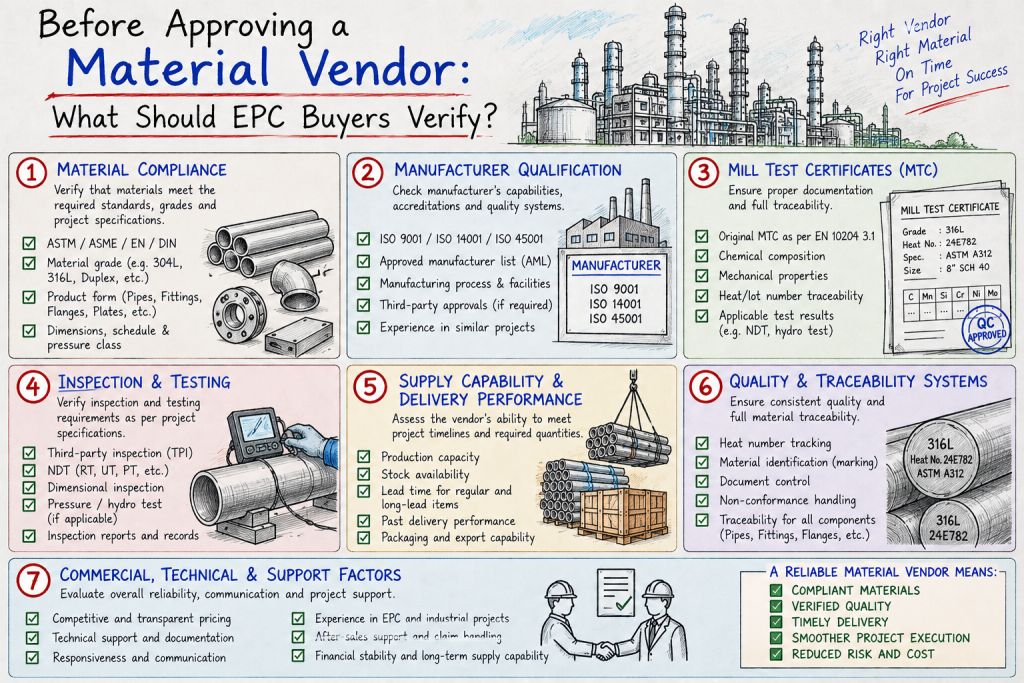
Before You Approve a Material Vendor: 7 Things EPC Buyers Should Check
Anyone who has spent time in EPC procurement knows the feeling. Two quotations land on your desk, one is clearly cheaper, and the pressure to go with it starts building. But a low price can get expensive fast. Rejected material, missing paperwork, inspection delays and late deliveries can all cost far more than the saving.
Whether you’re buying pipes, tubes, fittings, flanges or plates, the vendor deserves the same scrutiny as the material. Here are seven things worth checking before you sign anyone off.
1. Does the Material Match the Specification?
Start with the basics: can the vendor supply exactly what the project calls for? That means the right standard (ASTM, ASME, EN, DIN or whatever your specification names), along with grade, product form, dimensions, wall thickness, schedule, pressure class and end connections.
Close enough isn’t good enough here. Stainless steel grades like 304L and 316L, for example, are not interchangeable in every service. The right choice depends on design conditions, temperature and the corrosion environment. If you want a closer look at how grade decisions play out, our guide to stainless steel grade selection for petrochemical piping and our 304, 304L and 304H sheets and plates selection guide are good places to start.
Worth confirming:
- Compliance with the applicable material and product standards
- Correct grade, size, thickness, schedule and pressure rating
- The required product form and manufacturing route
- Compatibility with approved drawings and project specifications
2. Who Is Actually Making the Material?
It sounds obvious, but it’s often unclear. Is the vendor the manufacturer, an authorised distributor or a stockist? Each can be perfectly legitimate, but you should know which one you’re dealing with.
Look at their manufacturing capability, quality systems and track record on similar projects. An ISO 9001 certificate is a good sign that a quality management system exists, but it doesn’t prove that every product they ship meets your requirements. Treat it as one data point, not the whole answer.
Worth confirming:
- Who the manufacturer is, and how transparent the supply chain is
- Whether the vendor is on the approved manufacturer or vendor list, if one is required
- Relevant certifications and third-party approvals
- Experience with comparable materials on comparable projects
3. Check the Mill Test Certificates
MTCs are your paper evidence of what the material is: chemical composition, mechanical properties and identification details. When they’re missing, wrong or inconsistent, material acceptance can stall for days.
Before approving a vendor, make sure the right certificate type is available for the product and purchase order. Then check the details: heat number, grade, dimensions, standard and test results. Most importantly, check that the certificate matches what’s stamped on the physical material.
Worth confirming:
- The correct certificate type and standard, such as EN 10204 3.1 where specified
- Chemical composition and mechanical test results
- Heat or lot number traceability
- Consistency between the MTC, purchase order, markings and inspection records
4. Agree on Inspection and Testing Early
Inspection requirements vary a lot between projects and materials, and they should be settled before the purchase order is finalised, not after the material is on the dock.
Depending on the specification, that might mean dimensional checks, visual examination, hydrostatic testing, non-destructive testing (NDT) or third-party inspection. Not every test applies to every product, so let the inspection and test plan, the purchase order and the material standard define the scope.
Worth confirming:
- Inspection and test plan requirements
- Applicable NDT methods, such as RT, UT, PT or MT
- Dimensional and pressure testing requirements
- Third-party inspection and any hold or witness points
- Availability of inspection reports and test records
5. Be Realistic About Supply and Delivery
A vendor can be technically spot on and still hurt your schedule. Thin stock, optimistic lead times or production bottlenecks have a way of showing up right when construction needs the material.
Ask direct questions. Is the quoted material in stock, or does it have to be manufactured? Can it ship in phases? For long-lead items, agree on milestone dates and regular progress updates so there are no surprises.
Worth confirming:
- Current stock and production capacity
- Quantity availability and ability to deliver in phases
- Realistic lead times for standard and special-grade materials
- Past delivery performance and dispatch coordination
- Packaging, preservation and export documentation needs, where relevant
6. Look at How They Handle Quality Control and Traceability
Traceability is what connects the material on site to the paperwork in your file. A good vendor can follow a product from receipt and storage through inspection and dispatch, without losing track of which heat number belongs to which piece.
This matters most when a vendor is handling several grades, sizes or heat numbers at once, or material meant for different service conditions. Agree on marking, segregation and documentation requirements upfront.
Worth confirming:
- Material marking and identification procedures
- Heat or lot number tracking
- Document control and record retention
- How non-conforming material is handled
- Traceability between the physical material and its documents
7. Judge Commercial Reliability and Technical Support
Price still counts, of course. It just shouldn’t count alone.
When you compare quotations, make sure you’re comparing like with like. Differences in grade, standards, testing scope, documentation, packaging, freight, taxes and delivery terms can make two offers look similar when they aren’t. And pay attention to how a vendor communicates during the quoting stage. A team that answers technical questions promptly and clearly will usually be easier to work with when something needs sorting out mid-project.
Worth confirming:
- Transparent pricing and clearly defined commercial terms
- Technical responsiveness and documentation support
- Experience with EPC and industrial project requirements
- Clear commitments on delivery, inspection and documentation
- Ability to support repeat orders and long-term supply
Why a Proper Vendor Approval Process Pays Off
A structured approval process gets procurement, engineering, quality and project teams working from the same requirements. It helps catch avoidable errors early and gives everyone better visibility into compliance, inspection readiness and delivery commitments.
One caveat: vendor approval doesn’t replace checking the product itself. Every purchase order, material batch and delivery still needs to be checked against the project specification and acceptance criteria.
A Quick Checklist Before You Place the Order
- The materials meet the specified standards and grades.
- The manufacturer and supply chain satisfy project requirements.
- MTCs and traceability records are available as required.
- Inspection and testing obligations are clearly defined.
- Quantity and delivery commitments are realistic.
- Quality control and document management processes are adequate.
- Commercial terms and technical support expectations are clear.
The best vendor isn’t the one with the lowest quotation. It’s the one that meets your technical requirements, quality expectations and delivery schedule, and keeps doing it order after order.
Looking for a Reliable Piping and Steel Supplier?
Ratnadeep Steel & Engg. Co. supplies industrial materials for engineering and EPC requirements, including piping materials for EPC projects. If flanges are on your list, you can read about the different types of flanges or learn more about our work as a flange manufacturer in Mumbai.
You can browse the full product range, contact our team or send an enquiry for a quotation.