
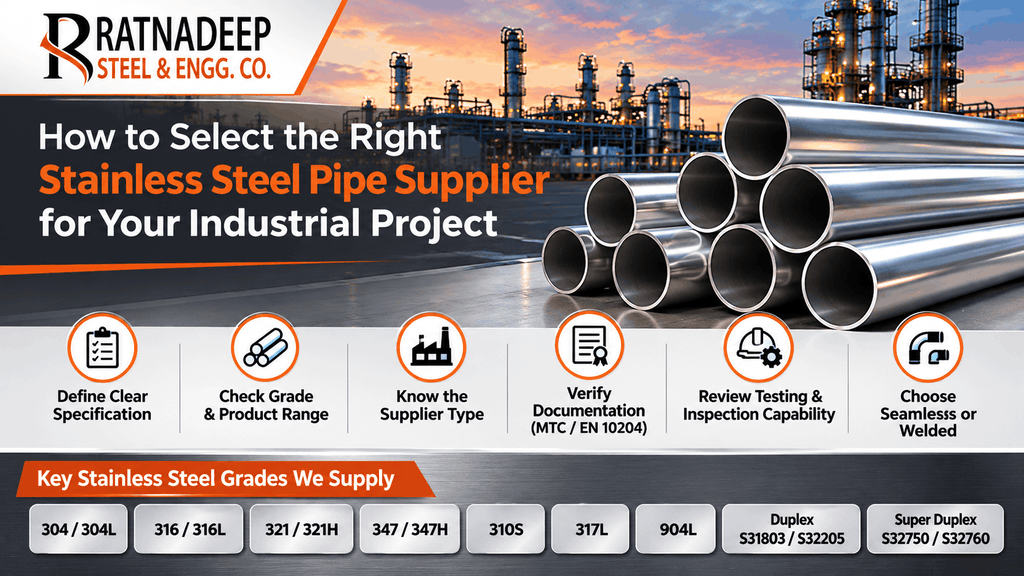
How to Select the Right Stainless Steel Pipe Supplier for Your Industrial Project
On paper, a stainless steel pipe order looks simple: grade, size, quantity, price. In practice, the supplier you pick shapes almost everything that follows. It decides whether the material matches your specification, whether the paperwork is in order when it reaches site, and whether your fabricators can start on the date you promised.
Choose well and the order passes quietly through procurement, inspection and installation. Choose badly and you can lose weeks to rejected material, missing certificates or a delivery that keeps slipping. Here’s a practical way to evaluate a stainless steel pipe supplier before you place the order.
1. Start With a Clear Specification
A supplier can only be as accurate as the enquiry they receive. Before you approach anyone, pin down the details:
- Material grade, such as 304/304L, 316/316L, 321 or duplex
- Applicable standard and specification (ASTM, ASME, EN or others)
- Nominal size, outside diameter, wall thickness or schedule
- Seamless or welded
- Quantity, lengths and delivery location
- Documentation and inspection requirements
This also gives you a fair basis for comparing quotations. If two suppliers quote against different assumptions, the cheaper number is rarely the better deal.
2. Check That They Actually Stock Your Grade and Range
Many suppliers list “stainless steel pipes” on their website. Fewer can supply the specific grade, size and product form your project needs. Look at how deep their range really is. For stainless steel, that might include:
- SS 304 / 304L pipes and tubes for general industrial service
- SS 316 / 316L pipes and tubes where better corrosion resistance is needed
- SS 321 / 321H and SS 347 / 347H for higher-temperature applications
- SS 310S, SS 317L and SS 904L for more specialised requirements
- Duplex S31803 / S32205 and Super Duplex S32750 / S32760 for demanding, corrosive environments
A supplier with a broad stainless range is also more likely to help if your design changes mid-project and you need to move from one grade to another. You can see the full range on our stainless steel pipes and tubes page.
3. Know Who You’re Dealing With
Is the supplier a manufacturer, a stockist or a trader? Each can be a legitimate source, but they offer different things. A manufacturer or established stockist is usually better placed to explain where the material comes from, answer technical questions and trace a heat number back to its origin. Ask directly, and ask for details of their supply chain if your project requires approved sources.
Quality system certificates such as ISO 9001 are a positive sign, but they don’t replace checking the product itself. Treat them as one piece of evidence.
4. Ask What Documentation Comes With the Pipe
For industrial work, the paperwork matters almost as much as the pipe. Before you order, confirm what will be supplied. Depending on your specification, that may include:
- Mill Test Certificates (MTCs), such as EN 10204 3.1 where specified
- Chemical composition and mechanical test results
- Heat or lot numbers that match the markings on the pipe
- Dimensional and inspection reports
- Third-party inspection certificates, if your project requires them
When the certificate, the purchase order and the markings on the pipe don’t agree, material acceptance can stall. A good supplier will talk about documentation upfront rather than after the order is placed.
5. Understand Their Testing and Inspection Capability
Different projects ask for different tests. Depending on the specification, these can include dimensional and visual inspection, hydrostatic testing, positive material identification (PMI) and non-destructive testing. Not every test applies to every pipe, so let your project specification and inspection and test plan decide the scope. What you want from the supplier is a clear answer on what they can carry out, what can be arranged through third parties, and how the reports are issued.
6. Match Seamless or Welded to the Service
Both seamless and welded stainless steel pipes have their place. The right choice depends on your pressure, temperature, size range, standard and budget, and your engineers should make that call from the project specification. A supplier that handles both product forms can discuss the options openly instead of steering you toward whatever they happen to have in stock.
7. Look at the Whole Piping Package
Pipes rarely travel alone. Most projects also need fittings, flanges and fasteners in compatible materials. Buying them from a single supplier can cut down on quotations, paperwork and mismatches between components. Ask whether the supplier can also provide:
For a broader view of how these categories fit together, see our article on piping materials for EPC projects.
8. Be Realistic About Stock, Lead Times and Delivery
A technically perfect supplier can still hurt your schedule. Ask whether the quoted material is available from stock or needs to be manufactured, whether it can ship in phases, and what lead time is realistic for your quantity. For overseas projects, ask about export packing, shipping documents and delivery terms too. Agree dates and progress updates for long-lead items so there are no surprises later.
9. Compare Quotations on the Same Basis
Price matters, but only when you’re comparing like with like. Check that each quote covers the same grade, standard, size range, testing scope, documentation, packing, freight and taxes. A lower rate per kilogram can hide a lower grade, a thinner wall or a lighter documentation package.
It also helps to think beyond the purchase price. In corrosive or high-temperature service, the grade you choose affects maintenance and service life for years. Our guide to stainless steel grade selection for petrochemical piping explains why total cost matters more than the rate per kilogram.
10. Pay Attention to How They Communicate
The quoting stage tells you a lot. Does the supplier ask sensible technical questions? Do they reply promptly and clearly? Do they flag a problem in your specification, or just say yes to everything? A team that engages properly before the order is usually easier to work with when something needs sorting out during the project.
Red Flags to Watch For
- A quote that is far below everyone else’s, with no explanation
- Vague answers about the manufacturer or origin of the material
- Reluctance to share sample certificates or documentation details
- Agreeing to every specification without asking a single question
- Unrealistic delivery promises with no stock or production plan behind them
- No clear point of contact for technical queries
A Quick Checklist Before You Choose
- They can supply the exact grade, size and product form you need
- You know whether they are a manufacturer, stockist or trader
- Certificates and traceability records are available as required
- Inspection and testing requirements are clearly agreed
- Stock, lead times and delivery terms are realistic
- Quotations are comparable on grade, standard, scope and terms
- They respond quickly and clearly to technical questions
Stainless Steel Pipes and Tubes From Ratnadeep Steel & Engg. Co.
Ratnadeep Steel & Engg. Co. supplies seamless and welded pipes and tubes from Mumbai, built to Indian and international standards, including IBR-approved grades for boiler and pressure applications. Alongside stainless steel, our range covers carbon steel, alloy steel, duplex and super duplex and nickel alloys, so you can discuss related requirements in one place.
You can explore our full pipes and tubes range, browse the grades we supply or read the technical information section for reference.
Share Your Specification for a Quote
Tell us the grade, size, standard and quantity, and we’ll confirm availability and revert with a quotation. You can contact our team or send an enquiry directly.
Ratnadeep Steel & Engg. Co.Manufacturer | Exporter | Supplier | Stockist
📞 +91 22 23871616 | +91 9930091290
📧 info@ratnadeepsteel.com
🌐 www.ratnadeepsteel.com
📍 Mumbai, Maharashtra, India
