
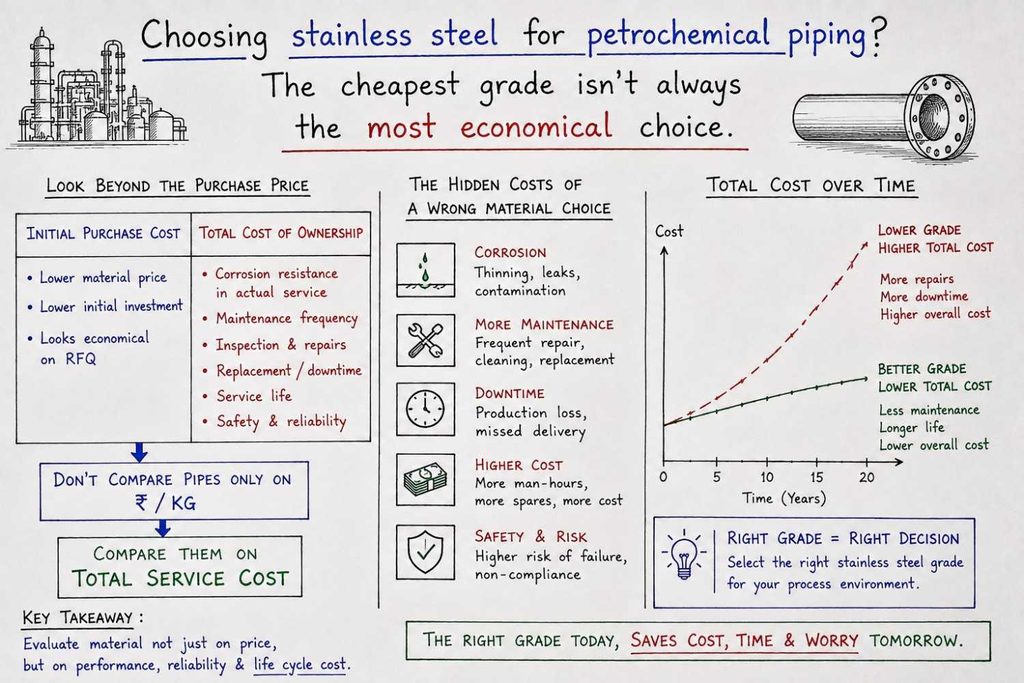
Stainless Steel Grade Selection for Petrochemical Piping: Look Beyond the Price per Kg
When a petrochemical plant is being specified, the lowest ₹/kg quotation for stainless steel pipes, tubes, fittings, flanges or sheets can look very attractive. It’s the number everyone can compare at a glance. But the cheapest material at purchase isn’t always the cheapest over the life of the plant.
Corrosion, inspections, repairs, replacement and unplanned shutdowns all add cost after the order has been placed, and they often add far more than the saving ever did.
That’s why engineers and procurement teams do better when they judge a stainless steel grade on performance, reliability and total cost of ownership, not just the price on the quotation.
Why the Purchase Price Can Mislead You
The price of the material is only one part of what a piping system costs. A lower-cost grade may meet the dimensional and mechanical requirements on paper, yet struggle in the real process environment. Chloride levels, acidity, temperature, pressure, fluid composition and operating cycles all affect how long a material lasts.
If the material corrodes or degrades earlier than expected, a plant may face:
- More frequent inspections
- Higher maintenance and manpower costs
- Repairs and component replacement
- Unplanned shutdowns and production losses
- Lower equipment reliability
- Potential safety and environmental concerns
Put together, the material with the lowest initial price can end up with the highest lifecycle cost.
Six Things to Weigh Before Choosing a Stainless Steel Grade
1. Corrosion Resistance in Your Actual Process
Don’t just reach for the grade everyone uses. Look at what’s actually flowing through the pipe: the composition of the fluid, moisture, chlorides, acids and any contaminants. A grade that performs well in one service can fail early in another, so the selection has to reflect the real corrosion mechanisms at work.
2. Operating Temperature and Pressure
As temperature rises, material properties and corrosion behaviour can change. Pressure, wall thickness and mechanical stress also come into play. The grade you choose has to satisfy the design and mechanical requirements for the conditions it will really see.
3. Chlorides and Aggressive Media
Chloride-bearing environments deserve extra attention. Depending on concentration, temperature and other factors, chlorides can lead to localized attack such as pitting and crevice corrosion.
Where the service is particularly aggressive, engineers may need to look at higher-alloyed stainless steels, duplex grades or other corrosion-resistant alloys instead of choosing on price alone. This is also why 304L, 316L, Duplex and Super Duplex shouldn’t be read as simply cheaper-to-dearer steps on a ladder. Each behaves differently and suits different environments.
4. Expected Service Life
How long does the system need to last? If the plant is designed to run for decades, a small difference in material cost can look trivial next to the cost of early replacement, maintenance and downtime. A grade that resists the environment better may be the better long-term value even when it costs more up front.
5. Maintenance and Inspection
Maintenance has a price too. If a material needs more frequent inspection, cleaning, repair or replacement, those costs build up over the years. And the bill isn’t only the replacement pipe. It includes labour, access, plant intervention and the downtime that comes with them. For critical systems, reliability is usually worth more than a small saving at purchase.
6. Standards and Traceability
Selection should also follow the applicable ASTM, ASME, ANSI, DIN, EN or BS standards for your project. For critical applications, certification and traceability matter just as much. Depending on the specification, that can include material test certificates, chemical composition, mechanical properties, heat numbers, dimensions and relevant inspection or testing records. They help confirm that what’s delivered matches the engineering specification.
304L vs 316L vs Duplex vs Super Duplex: Is Higher Alloy Always Better?
Not necessarily. Specifying the highest-alloyed, most expensive material for every line isn’t automatically good engineering. The aim is a material that gives you the right mix of corrosion resistance, mechanical performance, fabrication characteristics, availability and service life for that particular application.
Austenitic grades such as 304L and 316L are used widely across industry, while duplex and super duplex can offer advantages in tougher environments. Which one is right depends on the service conditions and the project specification. For a closer look at one family of grades, see our SS 304, 304L and 304H sheets and plates selection guide.
Instead of asking, “Which grade is cheapest?”
ask, “Which grade gives me the performance I need at the lowest overall lifecycle cost?”
Thinking in Total Cost of Ownership
A practical way to compare options is Total Cost of Ownership (TCO). Rather than looking only at the purchase price, you add up everything the material will cost over its life:
Here’s how that can change a decision. Say Grade A costs less per kilogram than Grade B. But in your environment, Grade A needs much more maintenance or has a shorter service life. The saving you made at purchase can disappear within a few years.
Grade B costs more to buy, yet it may last longer and need less attention. In that case the dearer material is actually the more economical choice.
Don’t Forget the Cost of Downtime
In a petrochemical or process plant, downtime is often the biggest cost of all. Replacing one piping component can involve far more than the pipe or fitting itself. Depending on the system, the job may need:
- Isolating the process line
- Depressurizing the equipment
- Draining or cleaning the system
- Inspection and maintenance
- Replacing the affected component
- Testing the system
- Restarting the process
The production lost during that time can easily outweigh the original difference in material price. This is why reliability deserves a place next to procurement cost, especially on critical lines.
Material Selection Is an Engineering Decision
Price matters, but it shouldn’t be the only line on the comparison sheet. A proper evaluation looks at:
- Process fluid composition and corrosion mechanisms
- Chloride exposure
- Operating temperature and pressure
- Mechanical, fabrication and welding requirements
- Expected service life
- Inspection and maintenance needs
- Applicable material and design standards
- Certification and traceability
- Availability and lead time
- Total lifecycle cost
When these are considered together, engineers and procurement teams can make a decision they won’t regret three years into operation.
The Key Takeaway
Don’t compare stainless steel pipes on purchase price alone. Compare them on total service cost.
The right grade, chosen at the start, lowers the risk of early corrosion, heavy maintenance, surprise replacements and disruption to operations. The goal isn’t to pick the cheapest material or the most expensive one. It’s to pick the right material for the application, balancing corrosion resistance, mechanical performance, service conditions, standards, reliability and lifecycle economics.
Explore our product range:
Stainless Steel Pipes & Tubes
Pipe & Tube Fittings
Flanges
Sheets & Plates
Stainless Steel and Special Alloy Products
Ratnadeep Steel & Engg. Co. supplies stainless steel and special alloy pipes, tubes, buttweld and forged pipe fittings, flanges, sheets and plates and other industrial steel products for demanding applications. Our range covers stainless steel, duplex, super duplex, alloy steel, nickel alloys and other special alloys, depending on application and project requirements.
We serve oil and gas, petrochemicals, power plants, pharmaceuticals, food processing, marine, construction and engineering industries.
Need the Right Material for Your Application?
Contact Ratnadeep Steel & Engg. Co. for stainless steel and special alloy pipes, tubes, fittings, flanges, sheets and plates for industrial and petrochemical applications.
Contact Us