
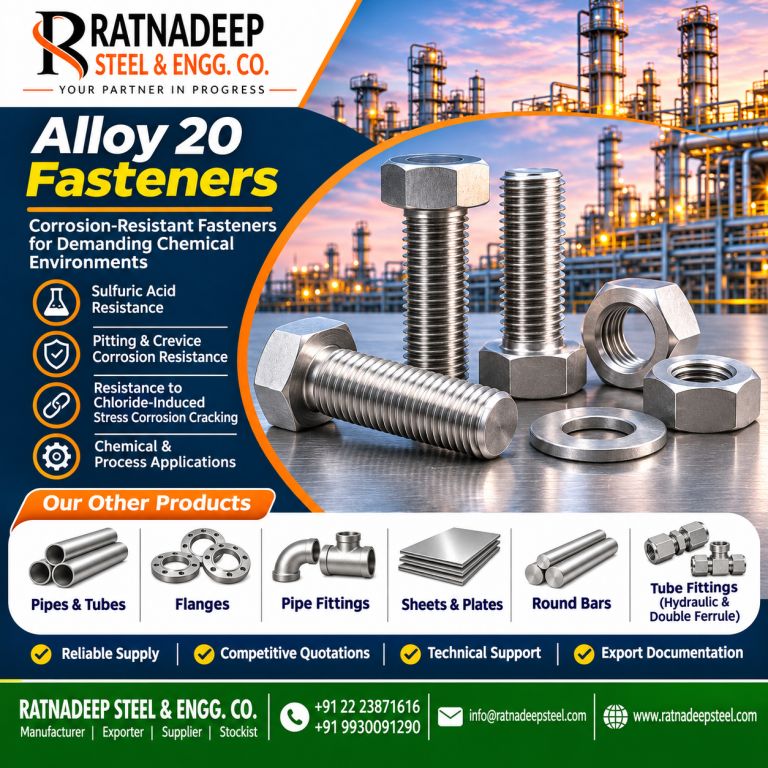
Alloy 20 Bolts: Properties, Applications and Specifications
Selecting the right fasteners is essential for maintaining the reliability and service life of industrial equipment, especially in corrosive chemical environments. Alloy 20 bolts are used in applications where resistance to certain aggressive chemicals, particularly sulfuric acid under suitable operating conditions, is an important material requirement.
Alloy 20, also identified as UNS N08020 and commonly associated with Werkstoff number 2.4660, is a nickel-iron-chromium alloy containing molybdenum and copper. Its composition provides useful corrosion resistance in selected chemical-processing environments. The correct fastener grade, manufacturing specification and suitability for the actual service conditions must always be confirmed before procurement.
Ratnadeep Steel & Engg. Co. supplies industrial fasteners in a range of materials and specifications. Explore our industrial fasteners range or view our dedicated Alloy 20 fasteners page for product details and enquiry options.
What Are Alloy 20 Bolts?
Alloy 20 bolts are fastening components manufactured from Alloy 20 material for applications that require a combination of mechanical performance and corrosion resistance. They can be considered for equipment assemblies, flanged connections and process systems exposed to compatible chemical environments.
The alloy’s nickel, chromium, molybdenum and copper content contributes to its corrosion-resistant characteristics. Niobium is also used to help stabilise the alloy. However, performance depends on factors such as chemical concentration, temperature, contaminants, flow conditions and the presence of other materials in the system.
Key Properties of Alloy 20 Bolts
1. Resistance to Sulfuric Acid
Alloy 20 is known for its performance in many sulfuric-acid environments. It is therefore considered for selected chemical-processing equipment, acid-handling systems and related industrial assemblies. The specific concentration and operating temperature should be checked against corrosion data before choosing the material.
2. Resistance to Pitting and Crevice Corrosion
The alloy can provide resistance to localised corrosion in suitable environments. Actual results depend on the chemical medium, temperature, deposits, joint design and operating conditions.
3. Performance in Demanding Industrial Applications
Properly specified Alloy 20 bolts can help secure equipment and connections in corrosive service. Their load-bearing performance, however, depends on the fastener dimensions, thread design, material condition, manufacturing process and applicable mechanical requirements.
4. Material Traceability and Specification Control
For critical applications, buyers should verify material identification, chemical composition, mechanical test requirements and traceability documentation. The selected specification should cover the actual finished fastener, not just the raw material from which it is made.
Common Types of Alloy 20 Fasteners
Depending on project requirements and availability, Alloy 20 fastening products may include:
- Alloy 20 hex bolts and heavy hex bolts
- Alloy 20 stud bolts and fully threaded studs
- Alloy 20 machine bolts and custom-designed bolts
- Alloy 20 nuts and lock nuts
- Alloy 20 screws and threaded rods
- Alloy 20 washers and other compatible fastening components
The type, dimensions, thread form, length and matching components should be selected according to the engineering drawings and joint design. Visit our Alloy 20 fasteners page to explore the product range.
Applications of Alloy 20 Bolts
Alloy 20 bolts may be considered for the following industries and applications when the alloy is compatible with the process environment:
- Chemical processing: Selected process equipment, tanks, reactors and piping assemblies.
- Fertiliser manufacturing: Equipment and connections exposed to compatible chemical media.
- Pharmaceutical production: Selected process systems where corrosion resistance and material documentation are required.
- Pickling and acid handling: Suitable equipment and fastening assemblies used in controlled chemical environments.
- Petrochemical and industrial plants: Applications where engineering review confirms the alloy is appropriate.
Alloy 20 should not automatically be assumed suitable for every seawater, chloride-rich or high-temperature application. Consult corrosion data and the project engineer before finalising material selection.
Alloy 20 Bolts: Specifications and Procurement Considerations
Correct specification is essential when purchasing Alloy 20 bolts for industrial projects. Buyers should define the following requirements before placing an order:
- Material identification: Alloy 20 / UNS N08020, with the required material condition.
- Product specification: Confirm the applicable material and finished-fastener standards with the project engineer and supplier.
- Dimensions: Bolt diameter, length, thread pitch, thread class and head style.
- Mechanical requirements: Required tensile properties, proof or yield requirements, and other tests specified for the finished fastener.
- Documentation: Material test certificates, heat or lot traceability, inspection records and positive material identification (PMI), where required.
- Installation requirements: Suitable lubrication, tightening method and anti-galling measures where applicable.
ASTM B473 is associated with specified nickel-alloy bar and wire products; it should not be assumed to define every requirement for a completed bolt. The applicable finished-fastener specification and dimensional standard must be confirmed for the actual product and service conditions. Always verify the current standard revision and project requirements.
Alloy 20 Bolts Compared with Standard Stainless Steel Bolts
| Consideration | Alloy 20 Bolts | Standard Stainless Steel Bolts |
|---|---|---|
| Material composition | Nickel-iron-chromium alloy with molybdenum and copper | Depends on the selected stainless steel grade |
| Chemical resistance | Useful resistance in many suitable sulfuric-acid environments | Varies significantly by grade and chemical conditions |
| Typical selection basis | Specific corrosive chemical service | General industrial, atmospheric or other suitable service |
| Cost consideration | May have a higher initial material cost | Depends on grade, size and availability |
Neither material is universally better. Selection should be based on corrosion data, mechanical loading, temperature, applicable standards, expected service life and total lifecycle cost.
How to Select the Right Alloy 20 Bolts
Before ordering, provide the supplier with the operating environment, chemical composition or process medium, temperature, pressure, required bolt dimensions, quantity and applicable project standards. Also confirm the required inspection documents and any third-party testing.
For bolted flange joints, ensure that bolts, nuts, gaskets and mating components are compatible with the joint design and operating conditions. Correct installation and tightening procedures are important for reliable performance.
Source Alloy 20 Fasteners from Ratnadeep Steel & Engg. Co.
Ratnadeep Steel & Engg. Co., based in Mumbai, India, offers a broad range of industrial fastening products for engineering and industrial requirements. Our product portfolio includes multiple material grades and fastener types, subject to the specified requirements and availability.
Explore our complete industrial fasteners range for different materials and applications. For product-specific details, visit our Alloy 20 fasteners page .
To discuss your application, dimensions, quantity, technical specifications and documentation requirements, contact Ratnadeep Steel & Engg. Co. through the relevant product page.
Frequently Asked Questions
What is Alloy 20 used for in bolts?
Alloy 20 bolts are considered for fastening applications in selected chemical-processing and acid-handling environments where the alloy’s corrosion resistance is suitable for the operating conditions.
Are Alloy 20 bolts suitable for sulfuric acid?
Alloy 20 performs well in many sulfuric-acid environments, but suitability depends on concentration, temperature, contaminants and other process conditions. Verify the service conditions before specifying the material.
What information should I provide when requesting Alloy 20 bolts?
Provide the material designation, dimensions, thread details, quantity, applicable standards, operating environment and required inspection documentation. Drawings and project specifications are helpful for custom requirements.
Where can I find Alloy 20 fasteners?
Visit the Alloy 20 fasteners page at Ratnadeep Steel & Engg. Co. for product information and enquiry options.
