
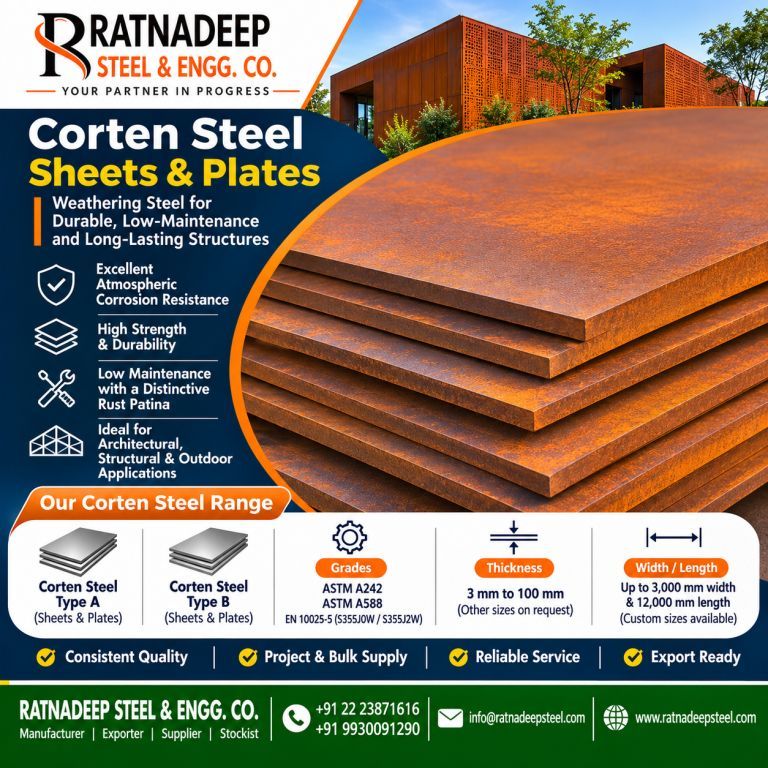
Corten Steel Plate vs Sheet: Type A vs Type B and How to Choose the Right One
If you’ve ever searched for a corten steel plate or a corten steel sheet, you’ve probably noticed how many questions come bundled with the price. Is it Type A or Type B? Is a 3 mm sheet enough, or do you need a plate? Will it really stop rusting? And what happens to the wall next to it once the patina starts to run?
These are the questions architects, fabricators, landscape designers and project buyers ask us most often. This guide answers them in plain language, so you can write a specification (and an enquiry) that gets you the right material the first time.
What Is Corten Steel?
Corten is a weathering steel. It contains small additions of copper, chromium and nickel, and when it’s exposed to the weather it forms a tight, rust-coloured layer on the surface. Unlike ordinary mild steel, where rust keeps flaking away and eating deeper, this layer sticks and slows further corrosion. That’s why corten is often left unpainted, and why people love its warm, weathered look.
The catch is that it needs to dry out between wet spells to build that layer properly. We’ll come back to that, because it’s where most problems start.
Corten Steel Sheet vs Plate: What’s the Difference?
The difference is thickness, and there’s no single worldwide cut-off. As a rough rule of thumb, thinner material is sold as sheet and thicker material as plate. Standards and mills draw the line in slightly different places, so don’t rely on the name alone. Always specify the exact thickness in millimetres.
- Corten steel sheet is the usual choice for cladding, screens, planters, signage, decorative panels and anything that needs bending, folding or laser cutting.
- Corten steel plate is used where thickness brings strength or rigidity: structural parts, bridges, containers, chimneys, heavy outdoor equipment and large sculptures.
At Ratnadeep, we supply both, in a wide range of thicknesses, widths and lengths. You can see the full range on our sheets and plates page, or go straight to our corten steel sheets and plates page for Type A and Type B.
Corten Type A vs Type B
Most enquiries come down to this choice. In simple terms, Type A is the architectural grade and Type B is the structural grade.
| Feature | Corten A | Corten B |
|---|---|---|
| European norm | S355J0WP | S355J2W |
| ASTM standard | A242 Type 1 | A588 Grade A/B |
| Tensile strength | 470–630 MPa | 485 MPa min |
| Elongation | 20% min | 21% min |
| Typical uses | Facades, cladding, architectural structures, containers, railway wagons | Bridges, structural components, heavy construction, transmission towers |
Mechanical values vary with the standard, the thickness and the mill, so treat the table as a guide and check the Mill Test Certificate for the actual heat you’re buying.
Choose Type A when appearance and patina are the priority, such as facades, cladding, screens, sculptures and light, weather-exposed structures.
Choose Type B when the material is carrying load or working in harsher conditions, such as bridges, chimneys, industrial frames and heavy outdoor equipment.
How Long Does Corten Take to Develop Its Patina?
Not as long as people fear, but not overnight either. In most climates the surface starts turning orange-brown within weeks, deepens over the following months and settles into a darker, more stable tone over a year or two. Rain, humidity, sun exposure and the way the panel is oriented all change the speed and the colour.
If you’re working on a project with a handover date, set expectations early. The first few months can look patchy or bright orange, and that’s normal.
Five Mistakes to Avoid When Using Corten
- Letting water sit on it. Corten needs wet-and-dry cycles. Water that pools, or surfaces that stay damp all the time, can stop the protective layer from forming properly. Design for drainage.
- Ignoring rust run-off. In the early months, rust-coloured water can stain concrete, stone and paving below. Plan drip details, or choose a finish for the surrounding surfaces that can cope with it.
- Using it in a salty or buried environment without checking. Coastal spray, de-icing salts and burial in soil are tougher conditions for weathering steel. If your project is near the sea, talk to an engineer before you specify it.
- Choosing the grade by price alone. A sheet that’s fine for a garden planter may be wrong for a structural frame. Match the grade to the job.
- Forgetting the thickness. Thin material can distort when it’s welded or cut, and in places where corrosion is more aggressive, a thicker section gives more margin. Ask your fabricator what thickness they recommend.
Where Corten Sheets and Plates Are Used
- Architecture and building: facade panels, wall cladding, roofing, pergolas and screens.
- Infrastructure: pedestrian bridges, walkways, highway structures, chimneys and pylons.
- Industrial equipment: containers, storage bins and transportation equipment that face the weather every day.
- Landscape and outdoor design: garden walls, planters, fire pits, sculptures and signage.
- Shipping and transport: shipping containers, cargo platforms and truck bodies.
- Public spaces: monuments, public installations and street furniture.
Sizes and Finishes You Can Ask For
Corten sheets and plates can be supplied hot-rolled or cold-rolled, in thicknesses from 0.3 mm up to 500 mm, widths from 1000 to 3500 mm and lengths from 1000 to 12000 mm, subject to grade and availability. Custom-cut sizes are possible too.
Surface options include black painted, PE coated, galvanized, colour coated, anti-rust varnished, anti-rust oiled and checkered. If you want the natural weathered look, say so in your enquiry, so the right surface condition is quoted.
A Quick Checklist Before You Order
- Grade and standard (Corten A or B; S355J0WP, S355J2W, ASTM A242 or A588)
- Exact thickness, width and length, or cutting sizes
- Hot-rolled or cold-rolled
- Surface condition or coating required
- Quantity and delivery location
- Documentation, such as Mill Test Certificates, and any inspection requirements
Send us these details and we’ll check availability and revert with a quotation. If you’re still comparing materials, you may also find our pages on mild steel sheets and plates and stainless steel sheets and plates useful.
Get a Quote for Corten Steel Plates and Sheets
Ratnadeep Steel & Engg. Co. is a manufacturer, exporter, supplier and stockist based in Mumbai, serving customers in India and overseas. Whether you need a few corten sheets for a facade or plates for a structural job, tell us what you’re building and we’ll help you pick the right grade and size.
Browse our Corten Steel Type A and B sheets and plates, contact our team or send an enquiry for a quotation.
Ratnadeep Steel & Engg. Co.Manufacturer | Exporter | Supplier | Stockist
📞 +91 22 23871616 | +91 9930091290
📧 info@ratnadeepsteel.com
🌐 www.ratnadeepsteel.com
📍 Mumbai, Maharashtra, India
