
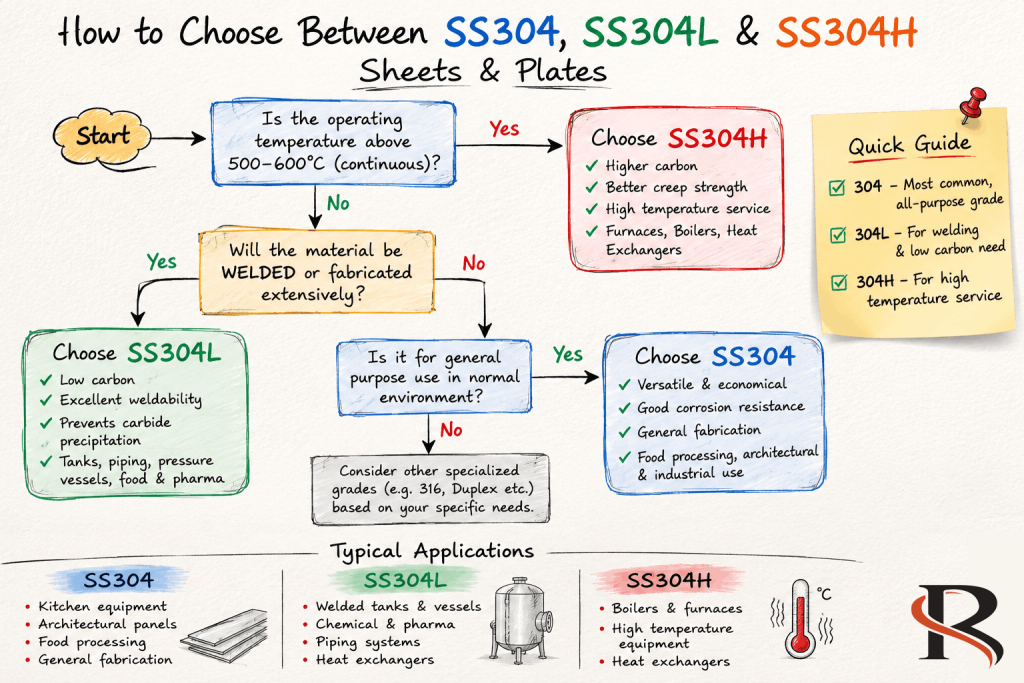
SS 304 vs 304L vs 304H Sheets & Plates: How to Pick the Right Grade
Picking the right stainless steel grade is not just about corrosion resistance. Your choice affects how well a part performs, how long it lasts, how easy it is to weld, how much heat it can handle, and how reliable it will be over time.
SS 304, 304L, and 304H all belong to the same family of chromium-nickel stainless steels. They look similar on paper. But small differences in carbon content make each grade better suited to different jobs.
Which Grade Should You Choose?
Your choice usually comes down to three things:
- Where and how the part will be used
- Whether it needs heavy welding
- How hot it will get in service
SS 304 — The General-Purpose Choice
SS 304 is the most widely used grade in this family. It balances corrosion resistance, formability, and strength well. That makes it a safe default for most everyday jobs.
Pick SS 304 when:
- You need solid, all-round corrosion resistance
- You need good formability
- The part runs at normal or moderate temperatures
- Heavy welding isn’t the main concern
- You want a flexible, do-it-all grade
Common uses: food processing equipment, architectural panels, tanks, and general fabrication work.
SS 304L — Built for Welding
SS 304L is the low-carbon version of 304. Welding heats up the metal near the seam. In regular 304, this heat can trigger chromium carbide buildup, which weakens corrosion resistance right where you need it most. Lower carbon in 304L avoids that problem.
Pick SS 304L when:
- The part involves a lot of welding
- Post-weld heat treatment isn’t practical
- You need strong corrosion resistance near welds
- You’re building tanks, vessels, piping, or process equipment
- You need good corrosion resistance and easy welding together
Common uses: welded tanks, pressure equipment, piping, chemical and pharmaceutical equipment, and heat exchangers.
SS 304H — Built for Heat
SS 304H has a higher carbon content than standard 304. That extra carbon boosts strength at high temperatures and improves creep resistance — the ability to resist slow deformation under constant heat and stress over time.
Pick SS 304H when:
- The equipment runs at high temperatures
- You need better creep strength for long-term heat exposure
- High-temperature mechanical strength matters
- You’re building boilers, furnaces, or heat exchangers
Common uses: boilers, furnaces, heat exchangers, pressure vessels, and other high-temperature equipment.
Quick Comparison
| Grade | Main Strength | Best For |
|---|---|---|
| SS 304 | All-round corrosion resistance and formability | General-purpose work |
| SS 304L | Low carbon, excellent weldability | Welded fabrication and process equipment |
| SS 304H | High-temperature strength and creep resistance | High-heat industrial service |
How to Choose: A Simple Checklist
Start with your real operating conditions and fabrication needs. Then match them here:
Go with SS 304 if:
- The job is general-purpose
- You need solid corrosion resistance
- You need good formability
- Temperatures stay normal to moderate
- You want one flexible grade for multiple uses
Go with SS 304L if:
- The part will be welded heavily
- Low carbon content helps your process
- You need corrosion resistance after welding
- You’re fabricating tanks, vessels, piping, or process equipment
Go with SS 304H if:
- The application runs hot
- You need better creep resistance
- High-temperature strength is critical
- You’re building boilers, furnaces, or heat exchangers
Standards: ASTM & ASME
SS 304, 304L, and 304H sheets and plates are usually specified under standard stainless steel product standards. For sheet and plate work — especially pressure vessels and general industrial use — ASTM A240 / ASME SA240 is the key spec to know.
Always confirm the exact specification, grade, dimensions, heat treatment, testing, and documentation against your project spec and purchase order.
Grade Equivalents
- SS 304: UNS S30400
- SS 304L: UNS S30403
- SS 304H: UNS S30409
SS 304 usually matches EN 1.4301. SS 304L usually matches EN 1.4306 or EN 1.4307, depending on the standard used. Always double-check equivalents against the relevant product standard and material certificate.
Where These Grades Are Used
The 304 family shows up across many industries thanks to its mix of corrosion resistance, strength, and easy fabrication.
- Food processing equipment
- Chemical processing equipment
- Pharmaceutical equipment
- Storage tanks and process vessels
- Piping systems
- Heat exchangers
- Pressure vessels
- Architectural and structural work
- Industrial fabrication
- Boilers and thermal equipment
SS 304, 304L & 304H Manufacturer & Exporter in India
Ratnadeep Steel & Engg. Co. supplies SS 304, 304L, and 304H sheets and plates for industrial, engineering, fabrication, process, and high-temperature applications.
We supply to international standards and project requirements — with the dimensions, finishes, testing, inspection, and documentation you need.
Choosing the right grade means looking at the whole picture: operating temperature, welding needs, corrosion environment, mechanical requirements, dimensions, and applicable standards.
Not Sure Which Grade You Need?
Tell us your operating temperature, welding requirements, service environment, and intended use. Our technical team will help you find the right grade and specification for your project.
Looking for SS 304 / 304L / 304H Sheets & Plates? Contact Ratnadeep Steel & Engg. Co. today.