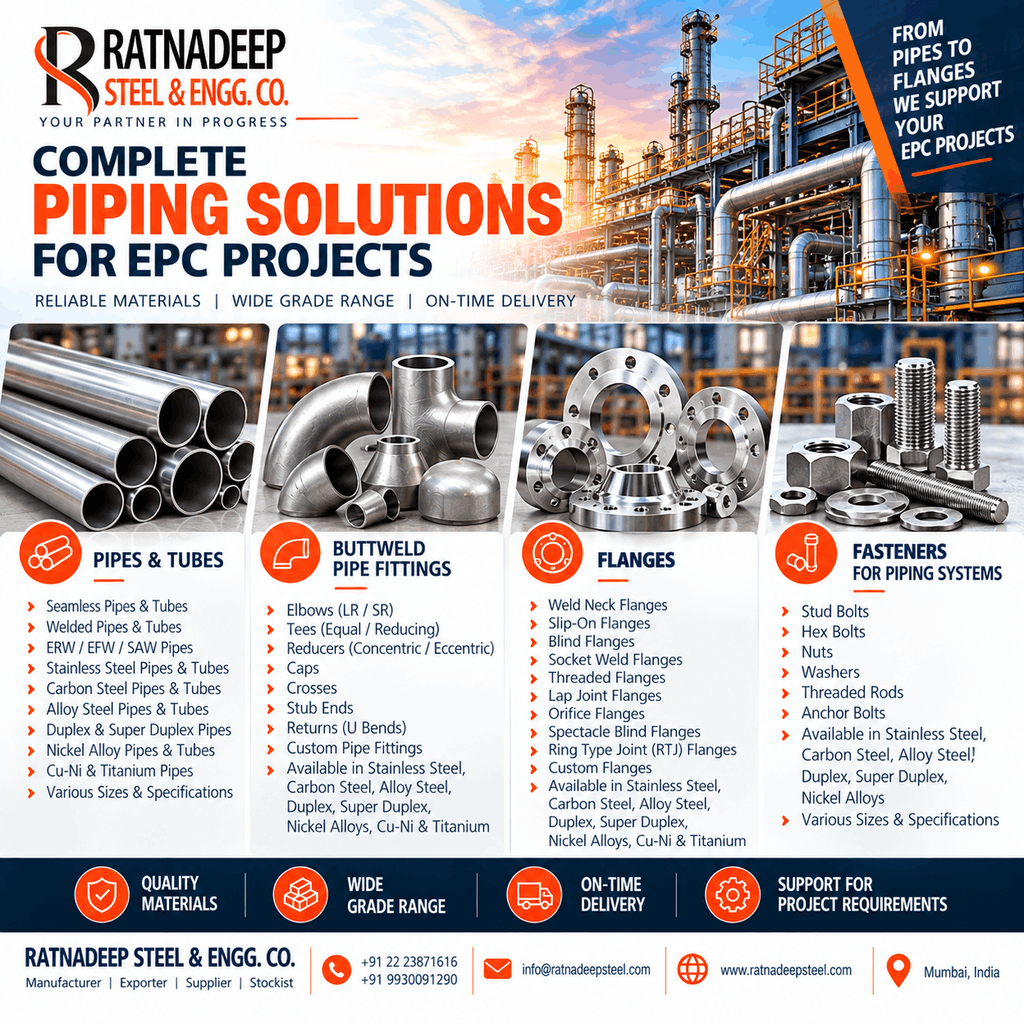
Sourcing Piping Materials for EPC Projects: Why One Reliable Supplier Makes a Difference
When you’re looking for a piping materials supplier for EPC projects, you quickly learn that the piping package is rarely simple. Ask anyone who has worked on procurement for a refinery, a power station or a chemical plant, and they’ll probably tell you the same thing. It’s not one item on a list. It’s pipes in three different materials, fittings to match, flanges in several types and pressure classes, and a box of fasteners that someone will inevitably need more of at the last minute.
When each of those categories comes from a different vendor, the coordination alone can eat up hours. That’s a big part of why many EPC teams prefer to work with a supplier that covers the whole piping range.
Here’s a look at what EPC projects typically need, and what to keep in mind when sourcing it.
What an EPC Piping Package Usually Includes
Whether it’s a process plant, a marine project or a water treatment facility, most piping requirements come down to four categories.
1. Pipes and Tubes
Pipes and tubes are the backbone of any piping system. Depending on the service, a project might call for seamless, welded, ERW, EFW or SAW pipe, and the material can vary a lot from one line to the next.
Commonly required materials include:
- Stainless steel
- Carbon steel
- Alloy steel
- Duplex and super duplex stainless steel
- Nickel alloys, including Inconel, Incoloy, Hastelloy and Monel
- Copper nickel
- Titanium
- Aluminium
This spread covers corrosive media, high temperatures, pressure service and other tough operating conditions.
2. Buttweld Pipe Fittings
Fittings change a system’s direction, size or configuration, and the exact mix depends on the piping layout, pressure class and project standards. A typical order might include:
- Long radius and short radius elbows
- Equal and reducing tees
- Concentric and eccentric reducers
- Caps, crosses, stub ends and returns
- Custom fittings for special requirements
Materials generally follow the pipe: stainless, carbon and alloy steel, duplex, super duplex, nickel alloys, copper nickel and titanium, subject to project requirements.
3. Flanges
Flanges give you detachable connections between pipes, valves and equipment, so choosing the right type and material matters for the integrity of the whole system. Common types include:
- Weld neck, slip-on, blind, socket weld, threaded and lap joint flanges
- Orifice flanges and spectacle blinds
- Ring Type Joint (RTJ) flanges
- Custom flanges
4. Fasteners
Fasteners are small, but a piping assembly doesn’t go together or stay maintained without them. Stud bolts, hex bolts, nuts, washers, threaded rods and anchor bolts are all part of the picture, and they can be sourced in stainless steel, carbon steel, alloy steel, duplex, super duplex and nickel alloys depending on the specification.
Why Combining These Categories Helps
EPC procurement is a juggling act. You’re managing materials, sizes, specifications and delivery schedules all at once, and a delay in one category can hold up the others.
Buying pipes, fittings, flanges and fasteners from one source doesn’t remove that complexity, but it does reduce the number of conversations, quotes and follow-ups you need to manage. It also makes it easier to keep materials consistent across components that have to work together.
Where This Material Gets Used
Piping systems turn up in almost every EPC sector:
- Oil and gas: refineries, gas processing facilities, terminals, pipelines and related process systems.
- Petrochemical: plants that deal with aggressive chemicals, high temperatures and demanding process conditions.
- Power generation: steam, water, cooling, fuel and other utility services, with material choice driven by operating conditions.
- Chemical processing: applications that often call for corrosion-resistant materials like stainless steel, duplex, super duplex and nickel alloys.
- Marine and offshore: environments where moisture and saltwater make material selection especially important.
- Infrastructure and industrial projects: utility systems, water treatment, process facilities and supporting installations.
Material Selection Is Not Just a Purchasing Decision
It’s tempting to treat piping materials as a line item, but choosing them is really an engineering decision. Operating temperature, pressure, corrosion conditions, dimensions, applicable standards and material compatibility all play a part.
Before placing an order, procurement teams should check the materials against the project’s approved specifications, drawings and service conditions. A supplier can help with the range and availability, but the specification is what everything gets measured against.
Who Ratnadeep Steel & Engg. Co. Works With
Ratnadeep Steel & Engg. Co. is a manufacturer, exporter, supplier and stockist of industrial piping materials. The company supplies pipes and tubes, buttweld fittings, flanges and fasteners across a wide range of materials, sizes and specifications, based on what each project needs.
That makes it a practical option for EPC contractors, engineering companies, project procurement teams, fabricators and industrial buyers, whether the requirement is for a new build, a plant expansion, maintenance or replacement.
You can explore the full Pipes & Tubes range and the Pipe & Tube Fittings range on the Ratnadeep website.
Get in Touch
If you’re planning an EPC project and want to talk through your piping requirements, you can reach Ratnadeep here:
Ratnadeep Steel & Engg. Co.Manufacturer | Exporter | Supplier | Stockist
📞 +91 22 23871616 | +91 9930091290
📧 info@ratnadeepsteel.com
🌐 www.ratnadeepsteel.com
📍 Mumbai, India