
High Quality Nickel Alloy Forged Pipe Fittings
200 • 201 • Strength • Sealing • Durability
Get a Quote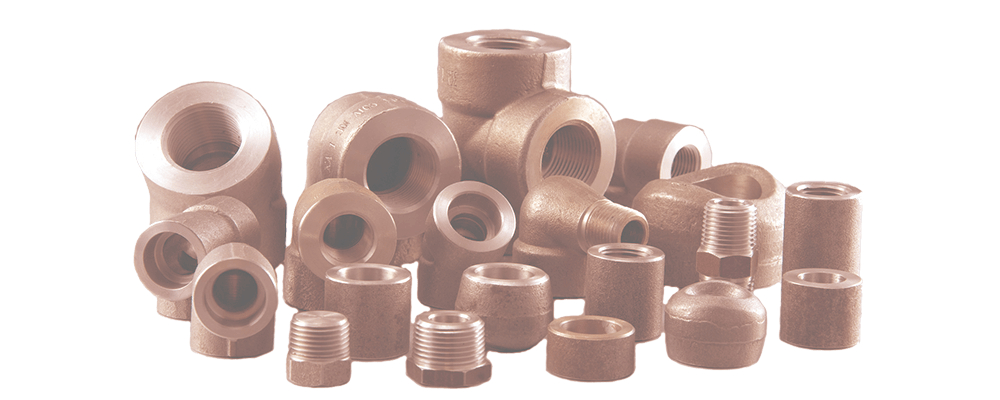
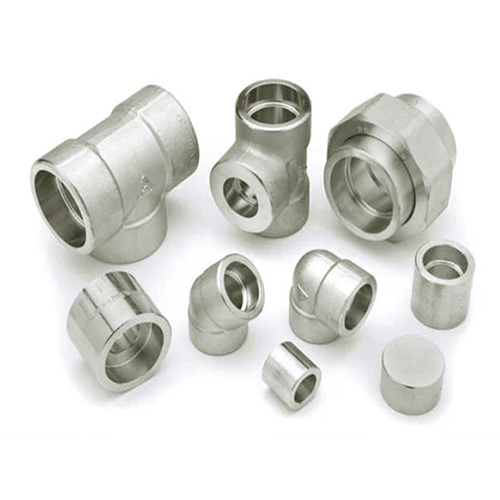
Nickel Alloy 200 Forged Fittings
- High-purity commercially pure nickel (99.6% Ni)
- Excellent resistance to alkalis, caustic solutions & neutral salts
- Outstanding thermal & electrical conductivity
- Best suited for temperatures below 315°C
- Resists dry fluorine, hydrogen chloride & reducing environments
- Ideal for chemical processing, food handling & synthetic fiber systems
- Used for elbows, tees, reducers, caps & custom forged fittings
- Excellent toughness and formability for cold working
- Recommended for high-purity, low-magnetic applications
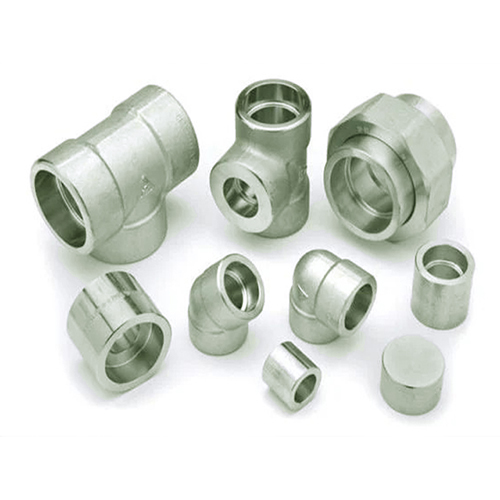
Nickel Alloy 201 Forged Fittings
- Low-carbon version of Nickel 200 for improved heat stability
- Prevents graphitization at temperatures above 315°C
- Better suited for high-temperature service compared to 200
- Excellent resistance to acid alkalis & reducing chemicals
- Ideal for caustic evaporators, reactor vessels & heat exchangers
- Lower carbon ensures superior metallurgical stability
- Commonly used in petrochemical, marine & aerospace systems
- Maintains ductility and mechanical properties at elevated temperatures
- Preferred for long-term exposure to high-temperature environments
Frequently Asked Questions About Nickel Alloy 200 & 201 Forged Pipe Fittings
What are Nickel Alloy 200 and 201 Forged Pipe Fittings?
Nickel Alloy 200 (UNS N02200) and Nickel Alloy 201 (UNS N02201) are commercially pure wrought nickel materials used to manufacture forged pipe fittings. These fittings are known for their excellent corrosion resistance, high thermal and electrical conductivity, and good mechanical properties across a wide temperature range. They are commonly available in types such as elbows, tees, reducers, caps, crosses, unions, and stub ends, manufactured to standards like ASTM B564 / ASME SB564 and ASME B16.11 [citation:1][citation:2].
What is the difference between Nickel 200 and Nickel 201?
The primary difference lies in their carbon content. Nickel 200 has a higher carbon content (max 0.15%), while Nickel 201 is the low-carbon version (max 0.02%) [citation:3][citation:10]. This makes Nickel 201 suitable for applications with operating temperatures above 315°C (600°F), where Nickel 200 might suffer from graphitization, which can compromise its ductility and corrosion resistance. For temperatures up to 315°C, Nickel 200 performs exceptionally well, while Nickel 201 is preferred for higher-temperature service, offering better resistance to intergranular corrosion [citation:3][citation:6].
What manufacturing standards and pressure classes are available?
Our Nickel 200 and 201 Forged Pipe Fittings are manufactured in compliance with ASTM B564 / ASME SB564 for material specifications and ASME B16.11, MSS SP-79, MSS SP-83, MSS SP-95, and BS 3799 for dimensional standards. They are available in pressure classes such as 2000 LBS, 3000 LBS, 6000 LBS, and 9000 LBS [citation:1][citation:2][citation:8]. These fittings are ISO 9001:2015 certified with PMI, NDT, and Third Party Inspection.
What types of forged fittings are available in Nickel 200 and 201?
We offer a complete range of forged fittings in both grades, including 45° and 90° elbows, equal and reducing tees, crosses, concentric and eccentric reducers, caps, unions, couplings (full and half), hexagon and reducing nipples, plugs, and bushings. Forged outlet fittings such as weldolets, sockolets, threadolets, and elbolets are also available [citation:1][citation:2][citation:8]. Customized dimensions are available upon request.
What are the typical mechanical properties of Nickel 200 and 201?
Both Nickel 200 and 201 offer a tensile strength of 55-75 ksi (380-520 MPa) with a yield strength of 15-30 ksi (105-210 MPa) at 0.2% offset. They have an elongation of 40-55% in 2 inches, demonstrating excellent ductility. The hardness is typically 90-120 Brinell (45-70 Rockwell B) [citation:10]. Both materials exhibit good fatigue strength and a shear modulus of approximately 70 GPa [citation:6].
What physical properties make Nickel 200 and 201 unique?
Nickel 200 and 201 are characterized by high ductility over a wide temperature range, high thermal and electrical conductivity, and good magnetostriction properties. They have a melting point of approximately 1435-1445°C and a density of 8.89 g/cm³. Their thermal conductivity at 20°C is about 69-79 W/m·K, and electrical conductivity is around 18-19% IACS [citation:3][citation:6]. Both materials are ferromagnetic with a Curie temperature of approximately 360°C.
Which industries commonly use Nickel 200 and 201 Forged Pipe Fittings?
These fittings are widely used across multiple industries, including chemical processing, petrochemicals and refineries, oil and gas, food processing, pharmaceutical, aerospace, power generation, and electronics. They are also used in applications requiring corrosion resistance to caustic alkalis, hydrofluoric acid, and other aggressive chemicals [citation:4][citation:5][citation:10]. For more information on the properties of these materials, you can visit MakeItFrom.com’s comparison of Nickel 200 and 201.
What testing and inspection do you perform on Nickel Alloy Forged Fittings?
Our Nickel 200 and 201 forged fittings undergo rigorous quality checks, including radiography testing (RT), ultrasonic testing (UT), hydrostatic testing, visual and dimensional examination, chemical composition analysis, and mechanical property testing. This ensures material compliance with strict industry standards and eliminates defects like misalignment, surface irregularities, and dimensional inconsistencies.
Do you provide material test certificates with Nickel forged pipe fittings?
Yes, we provide full material traceability with EN 10204 Type 3.1 (manufacturer’s test certificate) and Type 3.2 (third-party inspection) documentation. Additional testing — including PMI (Positive Material Identification), hydrostatic, ultrasonic, and NDT — can be arranged as per customer requirements.
Why choose Ratnadeep Steel for Nickel 200 and 201 Forged Pipe Fittings?
Ratnadeep Steel & Engg. Co. is a renowned manufacturer, exporter, and supplier based in Mumbai, India. We offer factory pricing, top quality, custom sizes, and timely delivery. Our fittings are precision-engineered using advanced forging techniques with rigorous quality inspection, making us a trusted global supplier of high-performance nickel alloy forged pipe fittings. View the technical datasheet for Nickel 200 and 201 for more detailed specifications.
Our Forged Pipe Fittings are manufactured using advanced forging processes and undergo extensive quality checks to ensure flawless dimensional accuracy, durability, and long service life. Each fitting is thoroughly inspected using key NDT techniques such as radiographic testing (RT), ultrasonic testing (UT), hydrostatic testing, and visual/dimensional examination. We also perform detailed chemical composition analysis and mechanical property testing to ensure material compliance with strict industry standards.
Throughout the forging and finishing stages, every forged fitting is monitored closely to eliminate defects such as misalignment, surface irregularities, and wall-thickness variations. This ensures perfect joint integrity and high-performance reliability in pipelines carrying high temperatures, pressures, and corrosive media. All our forged fittings fully comply with ASME, ASTM, MSS-SP, and related global specifications, making them a preferred choice for critical piping systems worldwide.
Request a Quote
Looking for high-quality Nickel Alloy 200 / 201 Forged Pipe Fittings? Fully compliant with ASTM B564, ASME SB564, and ASME B16.11. Get in touch with us today.
Contact Us