
What is Alloy Steel P91?
Alloy Steel P91 is a high-strength chromium-molybdenum alloy steel with vanadium and niobium (columbium) additions. It represents a significant advancement over traditional low-alloy steels, offering dramatically improved creep strength and oxidation resistance at temperatures up to about 600°C (1112°F). This allows for the design of thinner-walled, lighter-weight components that can operate at higher pressures and temperatures, leading to greater power plant efficiency. It is a normalized and tempered martensitic steel.
Alloy Steel P91
Chromium (Cr)
Molybdenum (Mo)
Vanadium (V)
Niobium (Nb)
Carbon (C)
Manganese (Mn)
Silicon (Si)
Nitrogen (N)
Iron (Fe)
Types of Alloy Steel P91 Pipes & Tubes
As specialists in high-performance alloys, we manufacture P91 pipes and tubes in both seamless and welded forms, adhering to strict heat treatment protocols to achieve the required high-strength martensitic microstructure.
P91 seamless pipes are essential for ultra-supercritical power plants and other advanced thermal systems. They are used for main steam lines, hot reheat lines, and headers where the combination of extreme pressure and temperature demands the superior creep strength of P91. The seamless construction is critical to handle the immense stresses without the risk of failure at a longitudinal weld seam, ensuring unparalleled safety and performance.
While less common than seamless due to the critical nature of its applications, P91 welded pipes are produced for specific large-diameter or custom-sized components. Their manufacture requires extreme precision in welding and a strict post-weld heat treatment (PWHT) cycle to develop the correct tempered martensite structure and achieve the necessary mechanical properties. They are used in applications like certain large-headers or structural supports within high-temperature plants.
P91 ALLOY STEEL PIPES EQUIVALENT GRADES
| STANDARD | Werkstoff /DIN | Other | Equivalent |
|---|---|---|---|
| A335 Grade P91 | 1.4903 | k91560 | X10CrMoVNb9-1 |
Specification of Alloy Steel P91 Seamless / Welded Pipes & Tubes
| Specification | Details |
|---|---|
| Specification | ASTM A335 / ASME SA335 |
| Dimensions | ASTM, ASME and API |
| Outside Diameter | 6-2500mm; WT:1-200mm |
| Wall thickness | 0.3mm – 50 mm |
| Size | 1/8″NB TO 30″NB IN |
| Type | Seamless / ERW / Welded / Fabricated Pipes |
| Form | Round, Square, Rectangular, Oval, Hydraulic Etc |
| Length | Single Random, Double Random & Required Length |
| End | Plain End, Beveled End, Treaded |
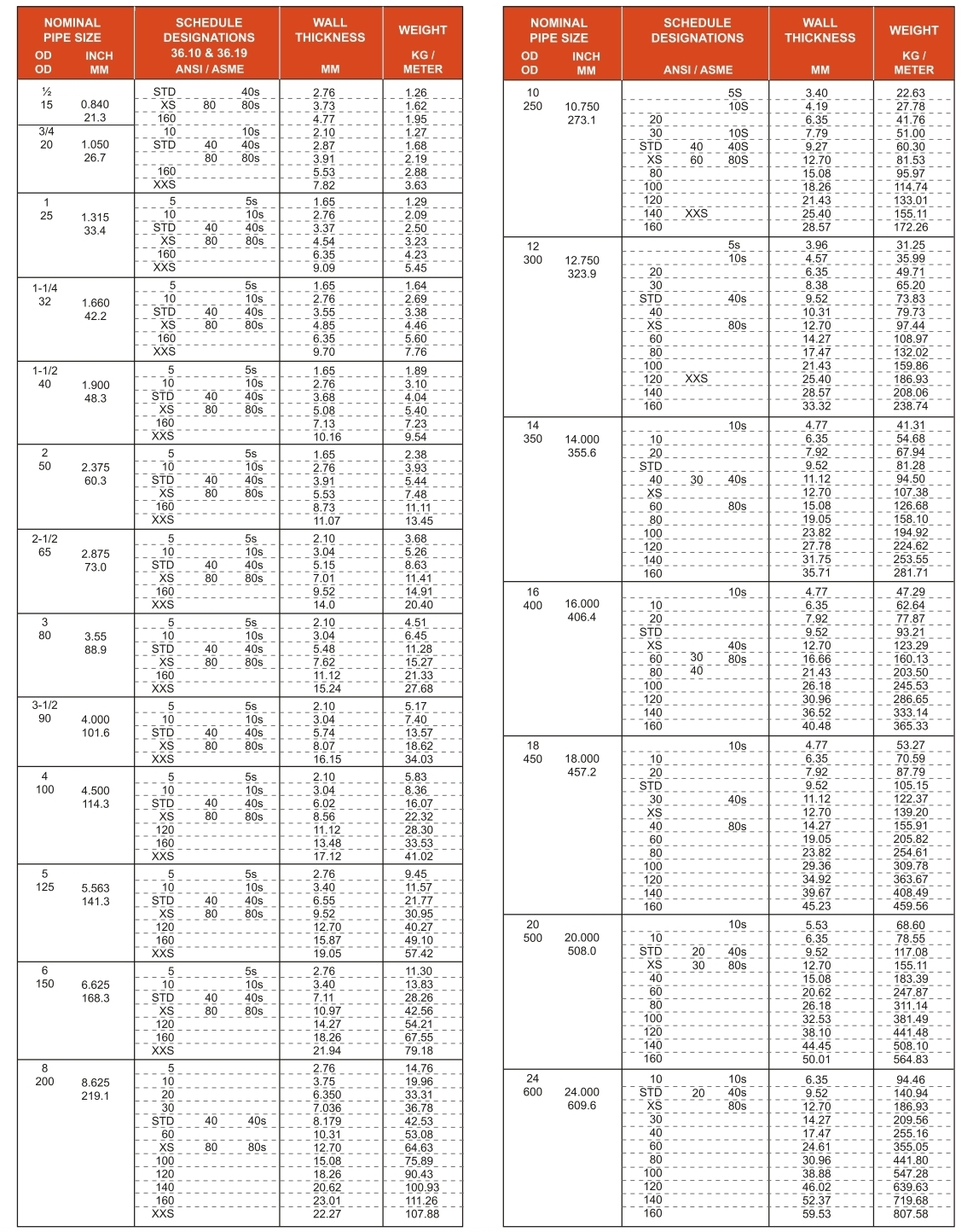
| Schedules | SCH 40, SCH 80, SCH 160, SCH XS, SCH XXS, All Schedules |
| Inspection, Test Reports | Mill Test Certificates, EN 10204 3.1, Chemical Reports, Mechanical Reports, PMI Test Reports, Visual Inspection Reports, Third Party Inspection Reports, NABL Approved Lab Reports, Destructive Test Report, Non Destructive Test Reports |
| Packing | Packed in Wooden Boxes, Plastic Bags, Steel Strips Bundled, or as per Customers Requests |
| Specials | Sizes and Specifications other than above can be manufactured on request |
ALLOY STEEL PIPE & TUBES SCHEDULE DIMENSIONS WALL THICKNESS, WT./MTR. (KG)
Click to expand ▼
CHEMICAL COMPOSITION OF ALLOY STEEL P91 SEAMLESS PIPES AND TUBES
| Grade | C, % | Mn, % | P, % | S, % | Si, % | Cr, % | Mo, % |
|---|---|---|---|---|---|---|---|
| P91 | 0.08~0.12 | 0.30~0.60 | 0.02 | 0.01 | 0.20~0.50 | 8.00~9.50 | 0.85~1.05 |
MECHANICAL PROPERTIES OF ASME SA335 ALLOY STEEL P91 PIPE
| Grade | Tensile Strength, MPa | Yield Strength, MPa | Elongation, % |
|---|---|---|---|
| P91 | 585 min | 415 min | 20 min |
💡 Practical Difference in Use
Use P91 when: you require high creep strength and excellent oxidation resistance for high-pressure, high-temperature service up to about 625°C (1157°F).
→ Example: Main steam and hot reheat lines, headers, and high-temperature superheater tubes in modern power plants.
Use P91 over other grades when: you are designing for higher thermal efficiency, which requires components to withstand higher steam pressures and temperatures with thinner walls compared to traditional steels like P22. → Example: Advanced ultra-supercritical (USC) power plant components.
Uses of Alloy Steel P91 Pipes
P91 (9Cr-1Mo-V) is a high-strength, advanced ferritic steel that revolutionized the design of high-temperature power plant components.
- High-Pressure Steam Piping: The dominant use is for main steam and hot reheat piping systems in supercritical and ultra-supercritical power plants.
- Boiler Headers: Used for superheater and reheater headers where its high strength allows for larger diameters with thinner walls.
- Heat Exchanger Tubing: Employed in high-temperature heat exchangers in process industries where its strength and corrosion resistance are beneficial.
Frequently Asked Questions About Alloy Steel P91 Pipes and Tubes
What is the chemical composition of Alloy Steel P91?
Alloy Steel P91 (UNS K91560) contains Chromium 8.0-9.5%, Molybdenum 0.85-1.05%, Carbon 0.08-0.12%, Manganese 0.30-0.60%, Vanadium 0.18-0.25%, Niobium 0.06-0.10%, and balance Iron. The vanadium and niobium additions provide precipitation strengthening for superior high-temperature performance.
What is the maximum service temperature for P91 pipes?
P91 alloy steel pipes can withstand continuous service temperatures up to 650°C (1200°F), with optimal performance in the range of 580°C to 625°C. This makes them ideal for advanced power generation applications requiring high efficiency.
What is the difference between ASTM A335 P91 and A213 P91?
ASTM A335 P91 covers seamless ferritic alloy-steel pipe intended for high-temperature service in larger diameters. ASTM A213 P91 covers seamless ferritic alloy-steel boiler, superheater, and heat-exchanger tubes in smaller sizes. Both use the same P91 grade with identical chemical and mechanical property requirements.
What are the main applications for P91 pipes?
P91 pipes are used in power generation (superheater tubes, reheater tubes, main steam lines), refineries, petrochemical plants, heat exchangers, pressure vessels, and high-temperature piping systems requiring exceptional creep strength and oxidation resistance at elevated temperatures.
Is P91 alloy steel pipe weldable?
Yes, P91 is weldable but requires strict adherence to welding procedures. Pre-heat temperature of 200-250°C is recommended, with post-weld heat treatment (PWHT) at 730-760°C for proper tempering and microstructure stability. The vanadium and niobium additions require controlled heat input to maintain properties.
What is the difference between P91 and P22?
P22 contains 2.25% Chromium and 1% Molybdenum, while P91 contains 9% Chromium, 1% Molybdenum with Vanadium and Niobium additions. P91 offers significantly higher creep strength (approximately 3 times stronger than P22 at 600°C) and better oxidation resistance, allowing for thinner wall designs in high-temperature applications.
What standards are used for P91 pipes?
P91 pipes are manufactured according to ASTM A335 for seamless pipes, ASTM A213 for seamless tubes, and ASME SA335. They also comply with DIN, EN, and IS standards. ASME Code Case 2192 specifically covers P91 material for construction of power boilers and pressure vessels.
What industries use P91 alloy steel pipes?
P91 alloy steel pipes are used in advanced power generation (supercritical and ultra-supercritical plants), refineries, petrochemical plants, nuclear power plants, heat exchanger manufacturing, and high-temperature industrial processing industries requiring exceptional creep strength and oxidation resistance.
Request a Quote
Looking for premium Alloy Steel P91 Pipes & Tubes? Ratnadeep Steel supplies ASTM A335 P91 seamless pipes, ASTM A691 P91 welded pipes, ASTM A213 T91 seamless tubes, and ASTM A369 FP91 forged and bored pipes for high-temperature and high-pressure applications. Contact us today for superior quality, competitive prices, and reliable worldwide delivery.
Contact Us